A safety harness can be an essential life-saving item when there is a genuine fall risk, but it is not automatically required simply because someone is working from a scaffold. The right answer depends on the scaffold’s condition, the stage of work, the protection already in place and the findings of a suitable risk assessment.
At 3SC Group Scaffolding, we have spent more than 20 years planning and delivering access solutions for homes, commercial sites, roofing projects and more specialised environments. One consistent lesson is that safe scaffolding starts with preventing a fall, rather than relying on a worker to arrest one after it happens.
Understanding the difference matters for everyone on site. Homeowners need reassurance that trades can work safely, while contractors and site managers need arrangements that are practical, compliant and appropriate for the task in hand.
A Harness Is Not the Default Answer for Every Scaffold
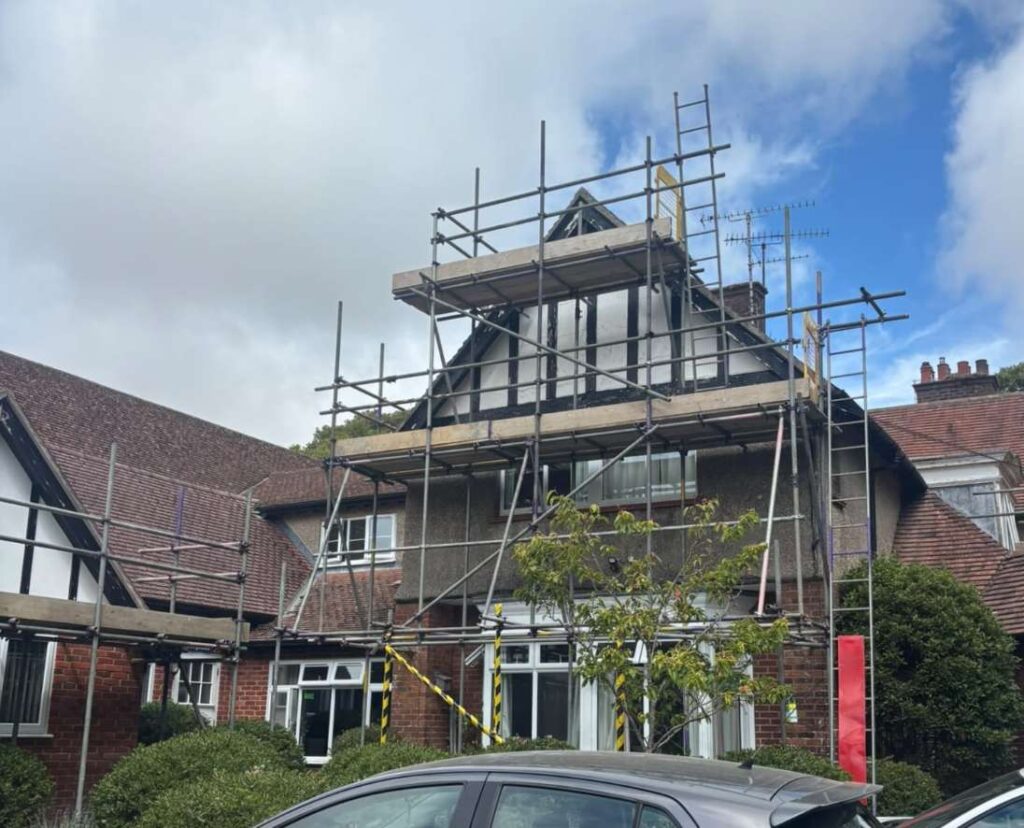
On a properly erected, inspected and complete working scaffold, edge protection is normally the primary means of preventing falls. This collective protection typically includes a top guard rail, intermediate guard rail and toe board, with fully boarded platforms and safe ladder or stair access where required.
Because these measures protect everybody using the platform, they are generally preferable to personal fall protection. A harness only protects the individual wearing it, and only if it is correctly fitted, connected to a suitable anchor point and supported by an effective rescue arrangement.
In practical terms, a roofer working from a completed independent scaffold with suitable double guard rails may not need to be clipped to a harness. That does not mean the work is risk-free: users must still keep platforms clear, follow site rules and avoid climbing on rails or using unsuitable access methods.
When a Harness May Be Necessary
A harness is more likely to be required during scaffold erection, alteration or dismantling, when there may be temporary gaps in collective edge protection. It may also be needed where the work involves unusual geometry, restricted access, open edges, incomplete platforms or a temporary scaffold arrangement that cannot provide full guardrail protection at every moment.
The decision must never be made by habit alone. It should be based on a task-specific assessment that considers the scaffold design, sequence of works, fall distances, surrounding hazards and the people carrying out the activity.
Situations that may call for personal fall protection include:
- Scaffolders erecting or striking lifts before full edge protection is in place.
- Temporary work beside an unprotected edge where a safer collective measure is not reasonably practicable.
- Accessing a specialist structure, such as a cantilever or suspended arrangement, where the safe system of work identifies it.
- Working around roof openings, fragile materials or exposed building edges beyond the protection provided by the scaffold.
- Short-duration changes to a scaffold where the designed protection must be temporarily removed and controlled.
Even in these circumstances, a harness should be one part of a wider safe system, not a quick substitute for planning. We regularly assess difficult sites with conservatories, garages, uneven ground or limited access, and the best outcome is often a revised scaffold layout that reduces the need for exposed work altogether.
Collective Protection Comes Before Personal Protection
UK work-at-height duties follow a clear principle: avoid work at height where reasonably practicable, prevent falls where work at height cannot be avoided, and minimise the distance and consequences of any fall where prevention is not possible. For scaffolding, that means considering safer access and edge protection before issuing harnesses.
Guard rails, toe boards, properly boarded lifts, brick guards, debris netting where appropriate and protected access routes all help create a safer environment for multiple people. Their effectiveness does not rely on every worker making the right connection every time they move around the scaffold.
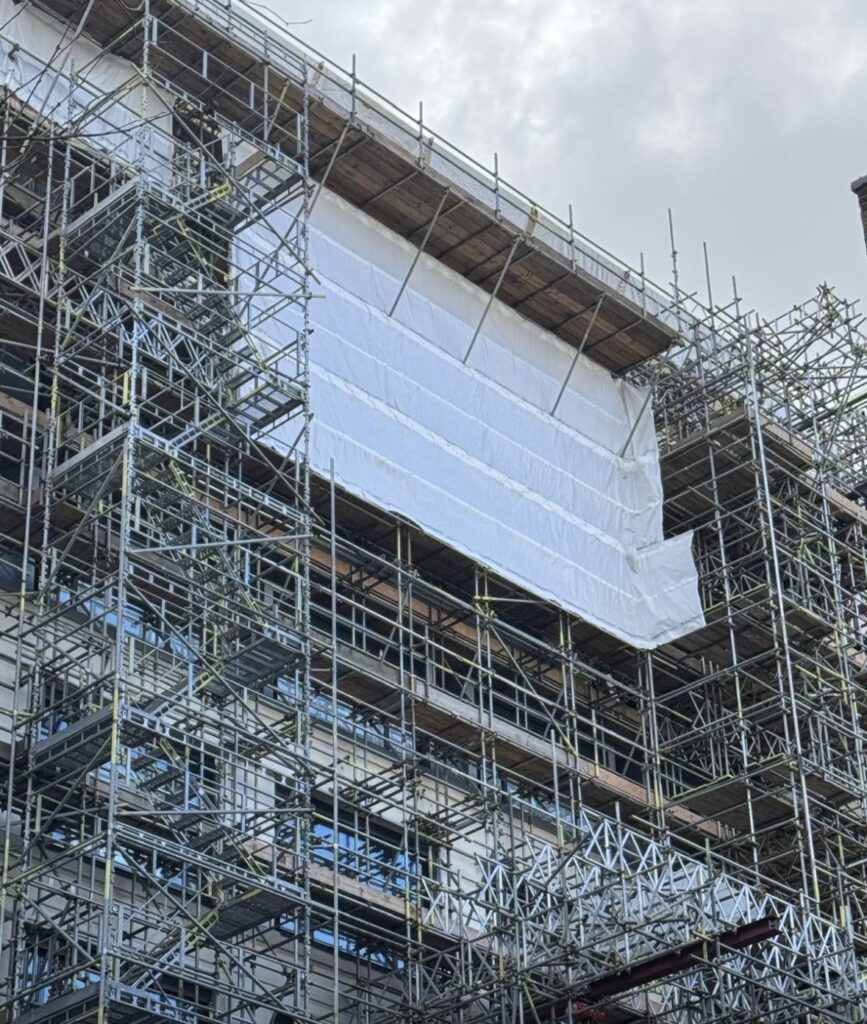
This is particularly important on busy refurbishment and re-roofing jobs, where roofers, builders, window installers and other trades may need access at different stages. A well-planned commercial scaffolding arrangement for busy sites should account for loading areas, access routes, public protection and the changing needs of the programme.
The Risks of Treating a Harness as Simple PPE
A harness looks straightforward, but it can create false confidence when it is used without the right equipment, training and supervision. Wearing one incorrectly, clipping onto an unsuitable point or using a lanyard of the wrong length can leave the worker exposed to a serious fall.
There is also a major difference between fall restraint and fall arrest. Fall restraint is arranged so that the person cannot reach a fall edge, while fall arrest allows a fall to occur before stopping it; wherever possible, preventing the fall is the safer option.
Fall arrest systems introduce further hazards. A person suspended after a fall may require urgent rescue, and the site must not assume that emergency services will provide an immediate retrieval solution.
Common harness-related mistakes we see discussed on sites include:
- Connecting a lanyard to a guard rail, ledger or tube that has not been identified as a suitable anchor point.
- Using a harness that is damaged, poorly adjusted, contaminated or overdue for inspection.
- Choosing an anchor point without considering clearance below the worker.
- Allowing a worker to operate alone without a practical rescue plan.
- Assuming a harness removes the need for a complete scaffold inspection.
- Using improvised or incompatible connectors, lanyards and attachments.
Equipment should be selected and checked by competent people in accordance with the manufacturer’s instructions and the site’s arrangements. If there is any doubt about where a worker can safely attach, stop and ask the scaffolding contractor or responsible site manager before work continues.
Harness Training and Competence Matter
Being issued with a harness is not the same as being competent to use one. Workers need relevant instruction and training on fitting, adjustment, pre-use checks, connector use, anchorage limitations, fall clearance and the rescue procedure for that specific workplace.
A good fit is vital. The harness should be the correct size, with leg straps, chest straps and buckles adjusted in line with the manufacturer’s instructions; loose straps can increase injury in a fall, while badly adjusted straps can restrict movement or lead people to remove the equipment.
Training must also reflect the actual task. A worker who understands a basic harness check may still be unfamiliar with the particular risks of an incomplete scaffold, a roof edge, a temporary roof or an access structure installed over an obstacle.
What Should Be Checked Before Anybody Uses the Scaffold?
Whether or not harnesses are part of the system, a scaffold needs to be safe for its intended purpose before trades begin work. This begins with a clear brief: what work is happening, which elevations are needed, what materials will be stored and whether the building, ground or public areas create extra constraints.
Our assessment process considers access, ground conditions, tie locations, loading requirements, nearby doors and windows, overhead services, weather exposure and the sequence of other trades. On domestic jobs, details that may seem minor, such as a conservatory roof or narrow side passage, can substantially affect the safe design.
A scaffold should then be inspected by a competent person before first use, at suitable intervals while in service, and after circumstances likely to affect safety, such as severe weather, impact or significant alteration. Users should also make a visual check before starting work and report missing boards, loose components, unauthorised changes or obstructed access immediately.
Before stepping onto a scaffold, workers should confirm that:
- The platform is complete, clear and suitable for the work planned.
- Guard rails and toe boards are in place where expected.
- Access is secure and not obstructed by materials or waste.
- The scaffold has not been altered since it was last checked.
- There are no obvious signs of damage, movement or unsafe loading.
- Any required controls, including a harness system, are understood before work starts.
If scaffolding occupies a footway or affects a public route, the planning extends beyond the work platform. Our explanation of pavement licence rules for home scaffolding outlines why permissions, pedestrian management and the scaffold footprint need addressing before erection.
Scaffold Design Can Reduce Harness Dependence
One of the most effective safety decisions happens before the first tube is lifted. A competent scaffold contractor can design the access around the actual work, avoiding the temptation for trades to overreach, climb outside protected areas or remove rails to make a task easier.
For example, chimney repairs often need a correctly positioned working lift that gives a mason safe room to handle materials without standing on a ladder above the platform. Purpose-built chimney access scaffolding for repairs can provide that stable, protected access while allowing the work to proceed more efficiently.
Other projects may need a loading bay, a temporary roof, an internal birdcage scaffold, a crash deck or a cantilever section. Each solution has limitations and must be designed, erected and used for its specific purpose; no generic harness rule can replace that professional assessment.
Responsibilities on Site
Responsibility for safe work at height is shared, although specific duties vary according to each party’s role. The person controlling the work must ensure that suitable planning, supervision and risk control measures are in place, while workers must use the scaffold and any supplied protective equipment as instructed.
Scaffolders should erect, alter and dismantle the structure in line with the agreed method and competent supervision. Trades should not move guard rails, remove boards, add makeshift platforms or attach personal protection to scaffold components without authorisation.
Homeowners can help by giving accurate information before the survey, keeping children and visitors away from the scaffold, and reporting any concerns quickly. They should not assume a scaffold is suitable for storage, access to extra parts of the property or tasks that were not included in the original brief.
What We Get Asked…
Do roofers always need a harness when working from scaffold?
No. If the scaffold provides complete, suitable collective edge protection and safe access for the task, a harness may not be necessary on the scaffold platform itself. The roofer’s wider work area, including the roof edge and any fragile surfaces, still needs its own risk assessment.
Can we clip a harness onto any scaffold tube?
No. Scaffold tubes and rails are not automatically approved anchorage points for personal fall protection. The attachment point and system must be specifically assessed as suitable by a competent person, with the required load capability, clearance and rescue arrangements considered.
Does a harness make an incomplete scaffold safe to use?
No. An incomplete scaffold should not be used by other trades unless it has been formally released for a clearly defined, controlled purpose. A harness does not correct missing boards, unstable access, inadequate edge protection or an unsafe scaffold configuration.
What happens after a person falls while wearing a harness?
The incident requires an immediate, rehearsed rescue response that is suitable for the location and equipment in use. Anyone involved should be assessed and the system taken out of service until the incident has been properly reviewed.
Our Final Thoughts
You do not automatically need a harness every time you work on scaffolding, but you do need the right level of fall protection for the precise task and conditions. A complete scaffold with effective guard rails is often the preferred way to prevent falls, while harnesses may be necessary for specific higher-risk stages or specialist access arrangements.
Do not leave that decision to guesswork or treat personal protective equipment as a replacement for sound scaffold design. Speak with us before your project starts so we can assess the site, understand the work sequence and provide access that supports safe, efficient working from erection through to dismantling.